

By Eric Mersch
AI governance is becoming a finance discipline. Here’s how CFOs can control AI token spend before it controls their budget.
We know that AI adoption is accelerating across every business function. AI governance for CFOs is rapidly becoming a core finance responsibility as organizations seek to balance innovation with financial discipline.
One of the core challenges here is that AI spending is growing even faster than governance.
Reporting on responsible AI benchmarks remains unclear. Documented AI incidents rose to 362 in 2025, up 55% from 233 in 2024.
While CFOs have decades of experience managing software licenses, cloud infrastructure, and travel expenses, generative AI introduces a new cost model that behaves very differently.
Unlike traditional SaaS subscriptions, AI costs scale with employee behavior.
Every prompt, every model selection, and every application design decision influences operating expenses. Organizations that fail to establish visibility early may find AI becoming one of their fastest-growing expense categories.
The good news: controlling AI spend requires applying the same financial discipline CFOs already use elsewhere in the business.
AI Has Changed the Economics of Software
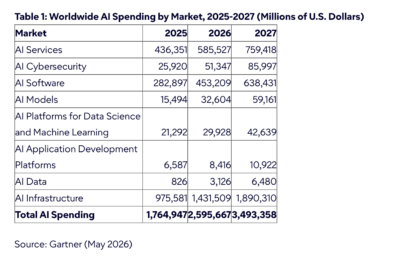
First, let’s look at the numbers. Gartner recently released a report predicting that worldwide AI spending will increase 47% this year alone. That’s $2.59 trillion (with a t) in 2026.
Here’s a breakdown of what that AI spending looks like:
Traditional enterprise software is relatively predictable. Costs generally increase as companies hire more employees or add licenses.
Generative AI is fundamentally different.
Inference costs grow based on:
- Frequency of use
- Size of prompts and context windows
- Choice of model
- Integration architecture
- Individual employee behavior
Two employees performing similar work can generate dramatically different AI costs simply by choosing different models or workflows.
For finance leaders, this means AI spending can accelerate long before anyone notices during the monthly close.
Visibility Must Come Before Optimization
One common pattern emerging across organizations is rapid month-over-month growth in token consumption.
In the FLG Partners’ AI Glossary, token is defined as follows:
A unit of text processed by an AI model, often representing a word, subword, or character.
Tokens are a good way to measure data processing because LLMs operate on sequences of tokens. Each token is converted into a numerical vector through an embedding process, allowing the model to learn patterns and relationships within the data. Additionally, measuring data in tokens provides a standardized metric to assess computational requirements and calculate costs. I think of a Token as the atomic unit of LLM activity.
In one FLG Partners engagement, monthly token spend increased more than 30% as employees:
- Increased overall AI usage
- Used larger context windows
- Defaulted to premium reasoning models even when lower-cost models would have produced comparable results
Without governance, these decisions are largely invisible until the invoice arrives.
The solution? Create clear guidelines and transparency.
Two Practical Controls Every CFO Should Consider
Here’s how to begin: organizations can introduce lightweight governance without slowing adoption.
1. Individual Token Budgets
Rather than treating AI as an unlimited shared resource, assign employees monthly token allocations.
Effective programs typically include:
- Individual monthly token budgets
- Real-time usage monitoring
- Simple approval workflows for additional capacity tied to business need
This approach maintains flexibility while introducing accountability.
Employees become more intentional about how they consume AI resources, much like they already manage travel or discretionary spending.
2. AI Cost Awareness Training
Most employees have little understanding of the economics behind AI models. Teach them.
Training should cover:
- Differences between premium reasoning models and lower-cost alternatives
- When advanced models genuinely add value
- How prompt design affects cost
- Practical guidance for matching the right model to the right task
Education often reduces unnecessary spending without reducing productivity.
Treat AI Like Any Other Managed Expense
Finance organizations should begin tracking AI usage with the same rigor applied to cloud infrastructure and software licenses.
Useful reporting dimensions include:
| Metric | Why It Matters |
| Employee | Identifies usage patterns and outliers |
| Business role | Enables meaningful benchmarking |
| Monthly inference cost | Measures actual spend |
| Premium model percentage | Highlights optimization opportunities |
Reporting should include usage across all major enterprise AI platforms, including:
- OpenAI (ChatGPT)
- Anthropic (Claude)
- Google (Gemini)
- Anysphere (Cursor)
While industry benchmarks are still emerging, organizations should expect significant variation depending on employee roles and AI maturity.
Customer-facing technical teams typically generate substantially higher inference costs than knowledge workers. More important than any absolute benchmark is understanding whether spending aligns with business value.
Why AI Governance for CFOs Is No Longer Optional
Historically, technology governance was viewed primarily as an IT responsibility.
However, as AI becomes embedded throughout business operations, finance leaders are increasingly responsible for ensuring that investment produces measurable returns.
Leading organizations are beginning to establish:
- AI usage policies
- Budget ownership
- Cost reporting
- Model selection guidelines
- Executive dashboards
- Ongoing governance reviews
These controls help organizations scale AI confidently rather than reacting to unexpected expense growth. CFOs and executive leaders can and should be proactive in their approach to AI governance.
The Next Competitive Advantage
The organizations that realize the greatest value from AI will not be those spending the most.
Successful AI scaling will reward the leaders that understand:
- Where AI creates measurable business value
- Which models are appropriate for each workload
- How to balance innovation with financial discipline
For CFOs, AI governance is quickly becoming as essential as cloud cost management, procurement controls, or software license optimization.
We’ve heard this story before: “You cannot optimize what you cannot measure.”
Organizations that establish reporting, accountability, and AI governance for CFOs today will be better positioned to scale AI responsibly while protecting profitability.
***
Frequently Asked Questions About AI Governance for CFOs
What is AI governance for CFOs?
AI governance for CFOs is the process of establishing financial controls, policies, reporting, and oversight to ensure AI investments deliver measurable business value while managing costs, risks, and compliance. It includes monitoring AI usage, allocating budgets, and creating accountability across the organization.
Why are AI costs increasing so quickly?
Unlike traditional software subscriptions, generative AI costs scale with usage. Factors such as prompt volume, model selection, context window size, and employee behavior all influence token consumption and inference costs. Without visibility into these drivers, AI expenses can grow rapidly before finance teams identify the trend.
How can CFOs reduce AI spending without limiting innovation?
Rather than restricting AI adoption, CFOs should focus on governance. Effective strategies include assigning token budgets, monitoring usage in real time, educating employees on model selection, and establishing reporting dashboards that connect AI spending to business outcomes. These controls improve efficiency while allowing teams to continue innovating.
What metrics should CFOs track for AI governance?
Key metrics include monthly AI spending, token consumption, inference costs by platform, premium model usage, employee or department-level usage, and cost per business outcome. Tracking these metrics helps finance leaders identify optimization opportunities and demonstrate return on AI investments.

Eric Mersch
Eric Mersch has over 25 years of executive finance experience including twice serving in public company Chief Financial Officer roles. Eric is an equity partner at FLG Partners where he works as an Interim CFO to venture and private equity portfolio companies, specializing in Strategy and Operations, Strategic Planning, Equity…Read More
