

By Eric Mersch
Mark Zuckerberg has frequently described Meta’s Llama AI models as open source.
Technically, that description remains contested.
The Open Source Initiative (OSI) defines open-source AI as providing the ability to use, study, modify, and share the system, supported by access to the information and code needed to understand and modify how it was created.
OSI has specifically argued that Meta’s Llama licensing does not meet that standard.
Open source vs. open-weight AI models
A more precise description of Llama is open-weight. Stanford University defines an open-weight AI model as “an AI model whose core components are publicly released, allowing anyone to download it. This lets users run the model on their own computers, study how it works, and even modify it for their own specific needs.”
In other words, developers can access trained model weights, run models themselves, fine-tune them, and build applications around them, subject to Meta’s licensing terms.
This differs from receiving everything required to reproduce the original model from the ground up.
For CFOs, however, the terminology may be the least interesting part of the story.
The bigger question is:
What happens to the economics of AI
if the foundational model itself becomes a commodity?
Meta Can Afford to Play a Different Game
It is easy to look at an AI model that cost billions of dollars to develop and ask why any company would give significant portions of it away.
That question assumes the company needs to monetize the model directly.
Meta does not.
Meta generated approximately $201 billion in revenue in 2025, including more than $196 billion in advertising revenue. Its economic engine remains the enormous audience and advertising ecosystem surrounding Facebook, Instagram, WhatsApp, and its other products.
That creates a very different incentive structure from AI companies whose economics depend more directly on monetizing access to proprietary models.
If the foundational AI model becomes cheaper and more widely available, Meta may still benefit because value can migrate to other layers of the technology stack: applications, infrastructure, data, distribution, and the customer relationship.
Meta has distribution at extraordinary scale. Its Family of Apps (FoA) averaged 3.58 billion daily active people in December 2025.
Making powerful models widely accessible can therefore be understood as a fierce competitive strategy.
If the competition is building tollbooths, one option is to make the road cheaper.
The Cost of Intelligence Is Already Falling
Evidence suggests this shift is already underway.
Stanford University’s 2025 AI Index found that the inference cost of a model performing at roughly GPT-3.5 levels fell more than 280-fold between November 2022 and October 2024.
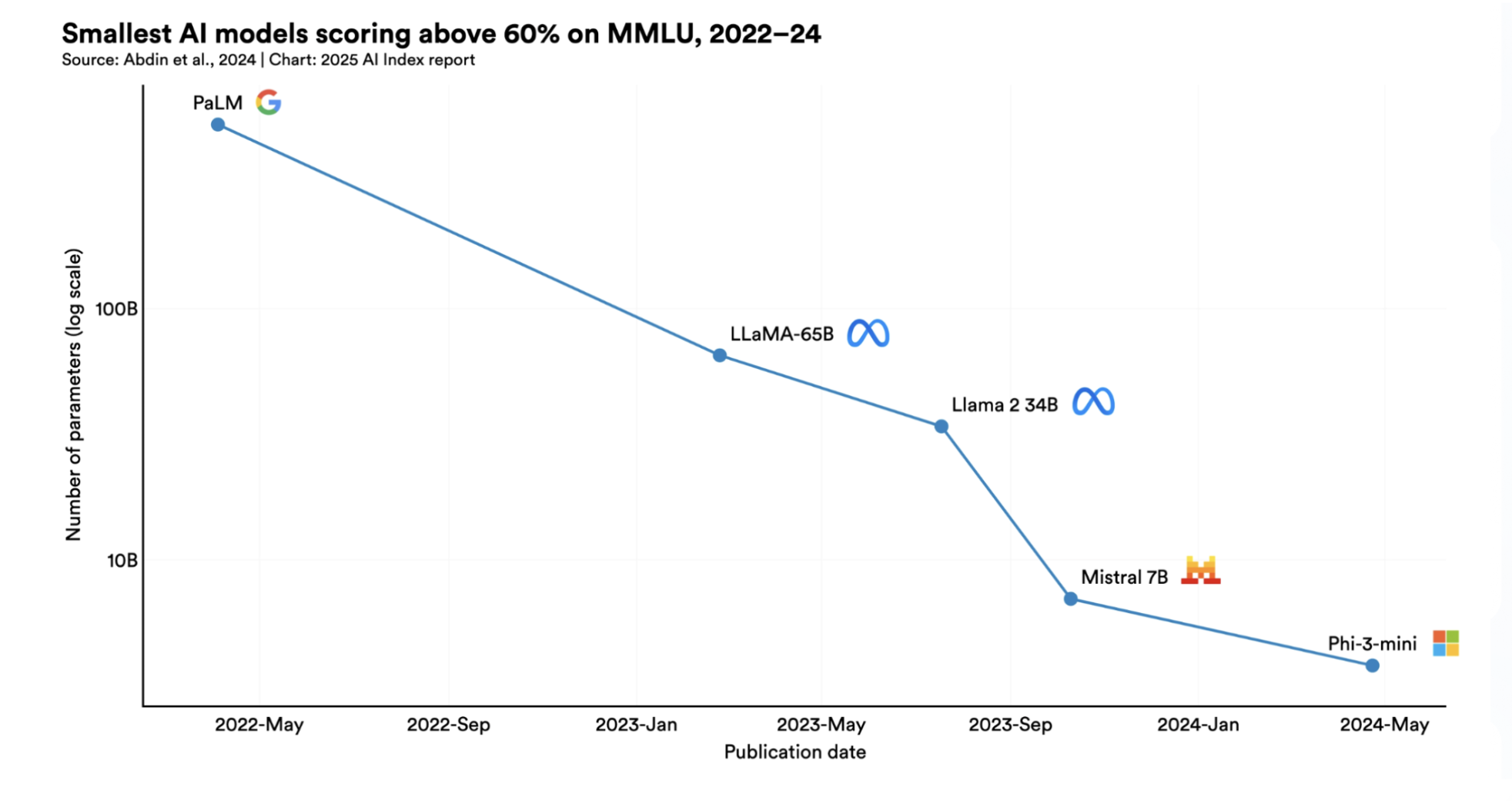
At the same time, open-weight models have become increasingly competitive with closed models. Although the performance gap continues to move as new generations of models are introduced, the larger trend is clear: capable AI is becoming much less expensive and much more widely available.
For a CFO, this creates an important distinction: The falling cost of the model does not necessarily mean the falling cost of AI. It may simply change where the company spends the money.
“Free” AI Is Not Free
An open-weight model can eliminate or reduce some API and licensing costs. But running it inside an enterprise creates an entirely different cost structure.
The organization may now be responsible for:
- Computing infrastructure and GPU capacity
- Cloud services, storage, and networking
- Deployment and integration
- Model customization and fine-tuning
- AI engineering and technical talent
- Cybersecurity and data protection
- Monitoring and model performance
- Governance, compliance and risk management
- Ongoing maintenance and upgrades
In summary, the cost can move from a vendor invoice into the company’s own technology and operating infrastructure.
Deloitte’s analysis of AI economics makes this distinction particularly important. Consuming proprietary AI through an API creates metered operating costs based largely on usage. Self-hosting models can provide greater control over long-term unit economics and data, but requires significantly more infrastructure, capital, and technical expertise.
That makes the open-versus-closed model decision something CFOs should recognize immediately:
It is a build-versus-buy decision with a new set of economics.
CFOs Need to Look at AI Through a TCO Lens
The wrong comparison is:
Model A costs $X per million tokens while Model B is free.
The better question is:
What is our total cost to deliver this AI capability at the required level of performance, reliability, security, and scale?
That means looking beyond model pricing.
- A company paying for a proprietary model may incur a relatively transparent variable expense.
- A company deploying an open-weight model may trade some of that expense for infrastructure, engineering, and operating costs.
Neither model is inherently cheaper. The economics depend on utilization, scale, workload, required performance, and how efficiently the organization operates the underlying infrastructure.
This is why AI increasingly belongs within the discipline of FinOps and financial planning rather than being treated solely as an IT procurement issue.
Flexera’s 2026 State of the Cloud Report found that estimated wasted cloud spend increased to 29%, reversing several years of improvement as AI and other infrastructure demands added new cost complexity. The same research found 81% of respondents were using generative AI.
AI adoption can therefore create a familiar problem at a much greater speed: decentralized technology consumption with limited visibility into cost or return.
The CFO’s Model Strategy Is Really a Portfolio Strategy
Companies also should not assume they need to choose between an entirely open-weight or entirely proprietary AI environment.
That is likely the wrong framework, and different workloads have different economics.
A highly sophisticated reasoning task might justify an expensive frontier model. A repetitive internal workflow may perform perfectly well on a smaller, less expensive model. A sensitive application may justify running an open-weight model within controlled infrastructure.
The CFO’s job is to help establish the financial framework for selecting the right economic architecture for each workload.
That requires asking questions such as:
- What business outcome does this AI workload support?
- What level of model performance does it actually require?
- What is the fully loaded cost per transaction, task, or business outcome?
- At what utilization does self-hosting become economically attractive?
- What infrastructure investment would that require?
- What costs are being transferred rather than eliminated?
- How portable is the application if model pricing or performance changes?
- Are AI costs visible and attributable to the business units generating them?
- What financial, regulatory, and operational risks accompany each architecture?
These questions become more important as the underlying models become more interchangeable.
Commoditization Could Shift Where the Profits Go
This is the strategic issue CFOs should watch.
When a foundational technology becomes commoditized, economic value does not disappear. It often moves somewhere else.
If model capabilities continue to converge while inference costs fall, competitive advantage may increasingly come from proprietary data, applications, workflow integration, customer access, infrastructure efficiency, and distribution. That could have major implications for companies investing in AI today.
Businesses should be cautious about building strategies around scarcity that may not exist several years from now. They should also avoid locking themselves into architectures that assume today’s model pricing, vendor landscape, or performance differences will remain intact.
This is particularly important because the economics are moving extraordinarily quickly.
The Stanford AI Index found that AI hardware price performance has been improving roughly 30% annually, while model inference prices have been falling dramatically faster for some workloads.
Today’s AI business case may therefore look very different in 24 months.
What CFOs Should Do Now
CFOs do not need to predict whether Meta ultimately succeeds in commoditizing foundational AI, but they do need to prepare for the possibility.
Start by making AI costs visible across the organization. Separate model costs from infrastructure, engineering, integration, security, and governance expenses so management can see the true total cost of ownership.
Then establish unit economics. Instead of simply asking how much the company spends on AI, determine what it costs to produce a useful business outcome.
Finally, preserve optionality. Where possible, avoid architectures that unnecessarily bind important workflows to one model provider.
Keep in mind: The model that is strategically important today may become a commodity tomorrow.
Meta is spending heavily on precisely this bet. The company invested more than $72 billion in capital expenditures during 2025 and initially projected $115 billion to $135 billion for 2026, with the increase driven largely by AI infrastructure and its Superintelligence Labs efforts.
Even the company attempting to drive down the economic value of the model believes enormous value will exist elsewhere in the AI ecosystem.
For CFOs, that may be the bigger lesson.
The key question right now is not about cost, but where the economics of AI are moving, and whether your company is investing in the part of the stack where value will ultimately accrue.
***
FLG combines deep CFO experience with a technology-enabled approach, selectively leveraging AI tools to improve analysis, efficiency, and decision-making, all under clear governance and experienced human oversight. Schedule a complimentary consultation to discuss your needs and how to approach AI spending and economics.

Eric Mersch
Eric Mersch has over 25 years of executive finance experience including twice serving in public company Chief Financial Officer roles. Eric is an equity partner at FLG Partners where he works as an Interim CFO to venture and private equity portfolio companies, specializing in Strategy and Operations, Strategic Planning, Equity…Read More
